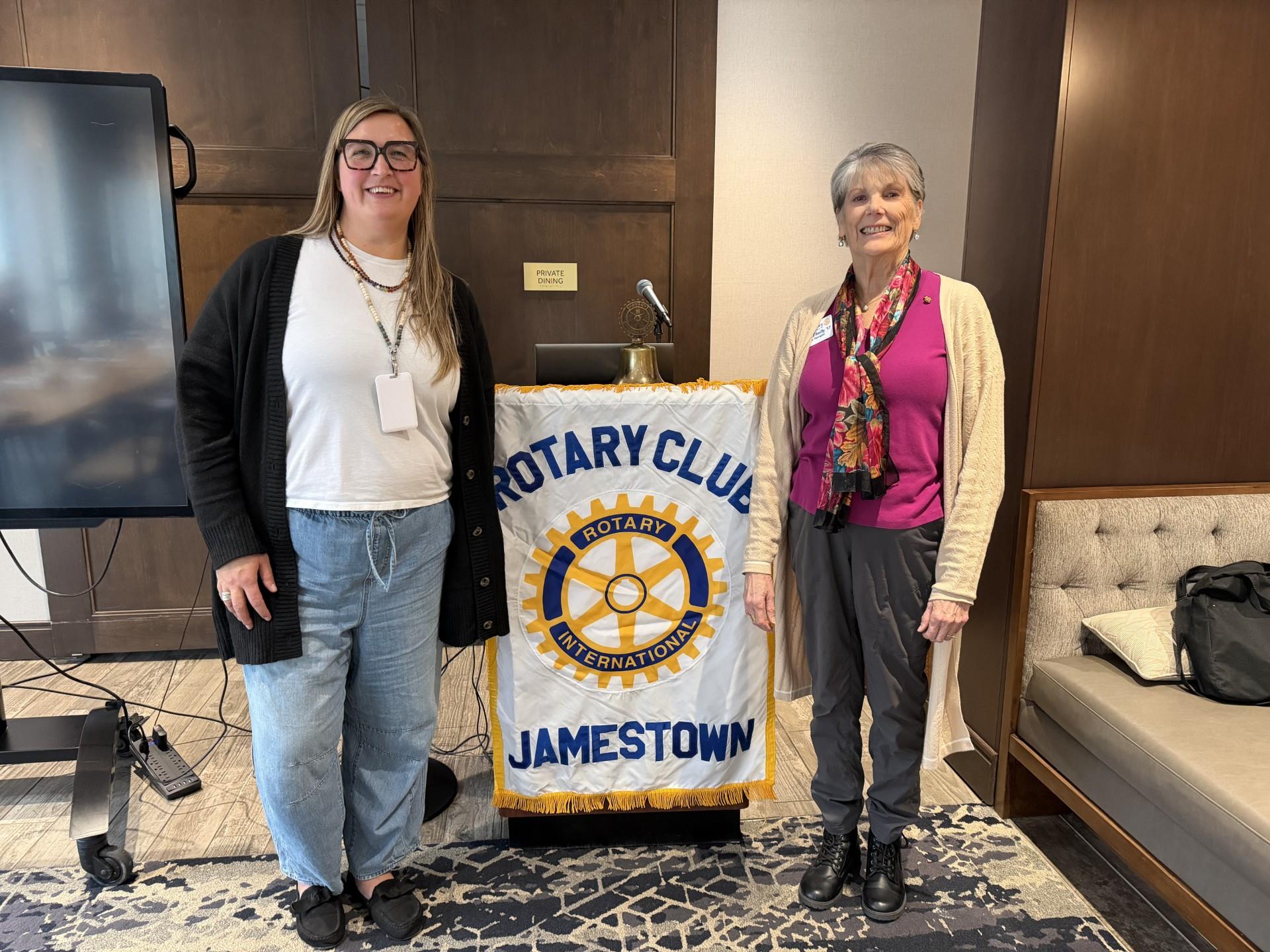
President Caitlin introduced AM Rotary Member Anna E. Powell, a Senior Public Health Sanitarian at the Chautauqua County Health Department where she has worked for the past 8 years. For the past 5 years, she has served as Childhood Lead Poisoning Prevention and Healthy Homes Program Coordinator. She manages the NYS Childhood Lead Poisoning and Rental Registry Programs and has secured and implemented HUD Lead Hazard Reduction, Health Homes Production, and NYS HCR Leading in Lead Prevention grants. She also serves on the Executive Committee for the Healthy @ Home CHQ Coalition to promote systems and policy change, focusing on building strong interagency collaboration and partnerships.
Powell presented an overview of childhood lead poisoning explaining that lead blocks neural connections in their brains, affecting learning capabilities and potentially causing ADHD and hearing loss. She described the traditional reactive approach to diagnose lead poisoning, which involves blood testing children at 1 and 2 years old and then testing homes and offering intervention if blood levels are elevated. She explained that 98% of childhood lead poisoning cases in our area stem from exposure in home environments, particularly in old housing stock built before 1978 when lead-based paint was banned for residential use.
She detailed the department's prevention programs, including home inspections for children under six in high-risk areas, and she introduced the new Lead Rental Registry program requiring inspections every three years of rental properties built before 1980. The presentation covered intervention methods, training opportunities for landlords, and various grant programs available to help property owners remediate lead hazards.
Anna explained that the health department runs voluntary prevention programs focusing on families with newborns in the 14701-zip code, particularly in Jamestown where about 75% of cases occur annually, and now they have expanded efforts to include Dunkirk. The program now follows children with blood lead levels 5 or above (down from 15 previously); coordinates with medical providers for testing requirements; and offers home inspections for homes built before 1978 where children under 6 live. The agency has a new proactive approach called the Lead Rental Registry, noting that previous legislation has been largely reactive rather than preventive, relying on children as lead detectors. The New York State lead rental registry program requires inspections every three years of rental units built before 1980. The program offers free training for landlords and workers on lead-safe renovation practices, as well as remediation supplies and grant opportunities for child-occupied homes.
The County holds an annual conference focusing on lead poisoning prevention efforts and sponsors community outreach activities and partnerships with cities and nonprofits. She explained their inspection process, noting they conduct approximately 200-250 prevention and intervention inspections annually using special detection devices to identify lead levels in homes. Anna clarified that while lead hazards exist in many properties where children are present, they offer flexibility in requiring permanent fixes for friction and impact surfaces that create lead dust be completed in 45 days, rather than requiring the entire building be lead-free, which could take a great deal of time and money and preserve historical home features.
Anna outlined the rental registry inspection process, which will increase from 200-250 presently to 1,600 inspections annually, and involves visual inspections and dust wipe samples to determine lead-safe certification. She noted that out of 55-60 completed inspections, only 7 (12%) have failed completely, indicating most properties are in good condition and manageable with proper maintenance.
Powell discussed the effects of lead poisoning on children, explaining that while blood lead levels can be reduced, the permanent damage cannot be reversed. She described the challenges in detecting lead poisoning through screening tests, particularly in young children, and outlined the support services available including behavioral assessments and therapy interventions. She emphasized that lead poisoning affects children differently depending on factors like gender and exposure levels and can manifest symptoms like ADHD that is detected usually after children start school.
Powell also highlighted how nutrition affects a child's ability to shed lead exposure. She explained that children with poor diets are more likely to retain lead in their bodies compared to those with nutrient-dense diets. She also mentioned that while the agency’s main prevention efforts focus on high-risk areas, they can still offer inspection services for rural homes such as the Amish community.
Members asked questions about testing requirements, remedial support for affected children, and historical context of lead exposure.